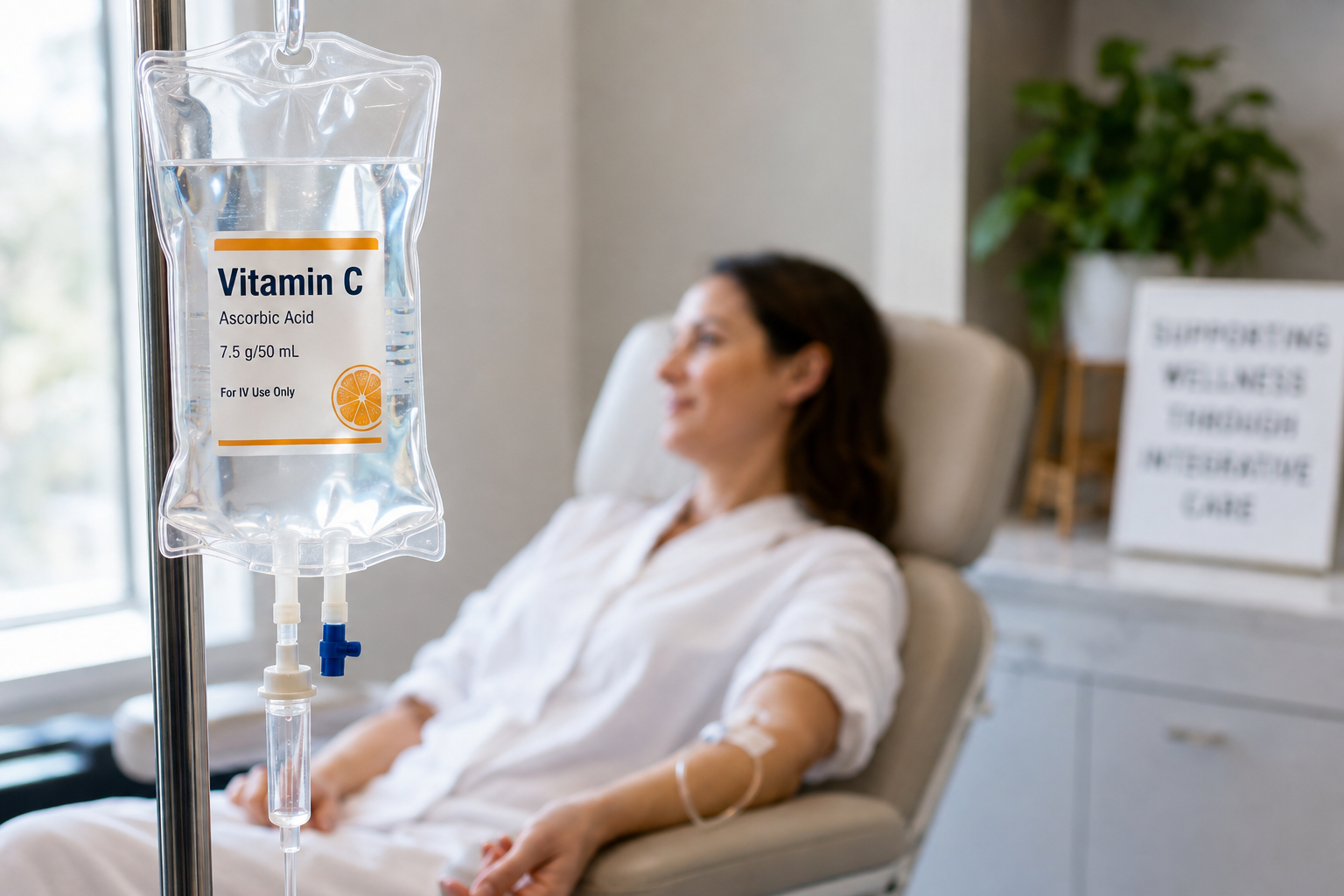
IV vitamin C is being studied as an adjunct to standard cancer treatment, with emerging evidence supporting further research.
IV Vitamin C for Cancer: What the Evidence Shows
By Jill Skurnowicz, ND, MS, CRNA | Natural Care Institute, Birmingham, MI
Almost every week, someone sitting across from me in Birmingham has already read something online about vitamin C infusions and wants to know whether it’s real or hype. IV vitamin C for cancer is one of the most genuinely interesting areas in integrative oncology right now — and also one of the most oversold. Here is what the research actually supports, where it falls short, and who should not receive it at all.
What IV Vitamin C for Cancer Actually Does
The whole story hinges on one detail: route of administration. Your gut tightly regulates how much vitamin C you absorb. Swallow more and you simply excrete more. Delivered intravenously, that ceiling disappears — infusions produce blood levels orders of magnitude higher than any oral dose can reach, according to the National Cancer Institute’s PDQ summary (cancer.gov/about-cancer/treatment/cam/hp/vitamin-c-pdq).
At those concentrations, vitamin C stops behaving like an antioxidant and starts acting as a pro-oxidant, generating hydrogen peroxide in tissue. Healthy cells carry plenty of catalase to neutralize it. Many tumor cell lines carry less, which is the proposed reason they appear more vulnerable. That mechanism has held up in laboratory work across pancreatic, colon, prostate, liver, and other cell lines.
This also explains why the famous 1980s Mayo Clinic trials found nothing. Those studies used oral vitamin C. They never reached the blood levels the mechanism requires — so they tested a different therapy entirely.
The Pancreatic Cancer Trial Worth Knowing About
In November 2024, University of Iowa researchers published a randomized phase 2 trial in Redox Biology. Thirty-four patients with stage 4 metastatic pancreatic cancer received standard chemotherapy (gemcitabine plus nab-paclitaxel) either alone or with high-dose IV vitamin C three times weekly.
Median overall survival roughly doubled — from about 8 months to about 16. The safety board stopped the trial early. Vitamin C did not worsen side effects, and patients reported better quality of life.
Now the honest caveats: 34 patients is small. Phase 2 is not phase 3. A single center is not replication. Larger trials are underway, and until they report, this is a promising signal — not proof, and not a reason to delay or decline standard oncology care.
The NCI’s broader read is measured in the same way: IV vitamin C has been generally well tolerated in trials, two studies showed improved quality of life and reduced treatment toxicity, and yet the overall body of research still suffers from design limitations. The FDA has not approved high-dose vitamin C as a cancer treatment. I tell patients that plainly.
Is IV Vitamin C for Cancer Safe?
Generally yes — with proper screening. This is exactly where drip bars and unsupervised clinics get people hurt.
Before a first infusion, we check:
- G6PD enzyme levels. Deficiency is an absolute contraindication. High-dose ascorbate can trigger red blood cell destruction in these patients.
- Kidney function. Vitamin C metabolizes to oxalate. Significant renal impairment, dialysis, or a history of calcium oxalate stones rules it out.
- Your full medication and treatment schedule. Timing relative to chemotherapy and radiation matters and belongs in a conversation with your oncologist, not around it.
This is complementary care, not alternative care. I encourage every patient to keep their oncology team in the loop, and I’m glad to send along lab results or infusion records at your request.
How We Approach It at Natural Care Institute
Infusions are one piece. Alongside them I look at protein intake, weight maintenance, and nutrient repletion — the fundamentals I cover in Cancer Nutrition Support (naturalcareinstitute.com/cancer-nutrition-support/) and in What Dr. Jill Tells Every Patient Facing Cancer (naturalcareinstitute.com/what-dr-jill-tells-every-patient-facing-cancer/).
Patients often ask what else we offer intravenously. I’ve written about the evidence behind IV Glutathione (naturalcareinstitute.com/iv-glutathione-therapy-birmingham-mi/), and for NAD+ (naturalcareinstitute.com/nad-iv-therapy-birmingham-mi/) I usually recommend subcutaneous injection rather than infusion — it delivers comparable benefit without a 2-to-4-hour chair time, which matters enormously when someone is already spending long days in treatment.
Frequently Asked Questions
Does vitamin C interfere with chemotherapy?
This is the most common concern, and the data so far do not support it. In the trials conducted to date, adding IV vitamin C did not reduce chemotherapy effectiveness or increase side effect severity. Still, every regimen is different — coordinate timing with your oncologist.
Can I just take vitamin C pills instead?
No. Oral dosing cannot reach the blood concentrations the anti-tumor mechanism depends on. Pills are worthwhile for general nutrient status; they are not a substitute for infusion therapy.
How long does an infusion take?
Plan on one to three hours, depending on your dose. Protocols commonly run two to three times weekly during active treatment, and your dose is calculated individually rather than picked from a menu.
Talk With Us
If you or someone you love is in treatment and wondering whether IV vitamin C makes sense, let’s look at your labs, your regimen, and your goals together. Call Natural Care Institute at (248) 845-8516 or schedule a consultation at naturalcareinstitute.com/appointments/. We serve Birmingham, Bloomfield Hills, Royal Oak, and the greater Detroit area.
This article is educational and is not medical advice. It does not diagnose, treat, or cure any condition. IV vitamin C is not an FDA-approved cancer treatment and is not a substitute for care directed by your oncologist. Always discuss complementary therapies with your treating physician.