
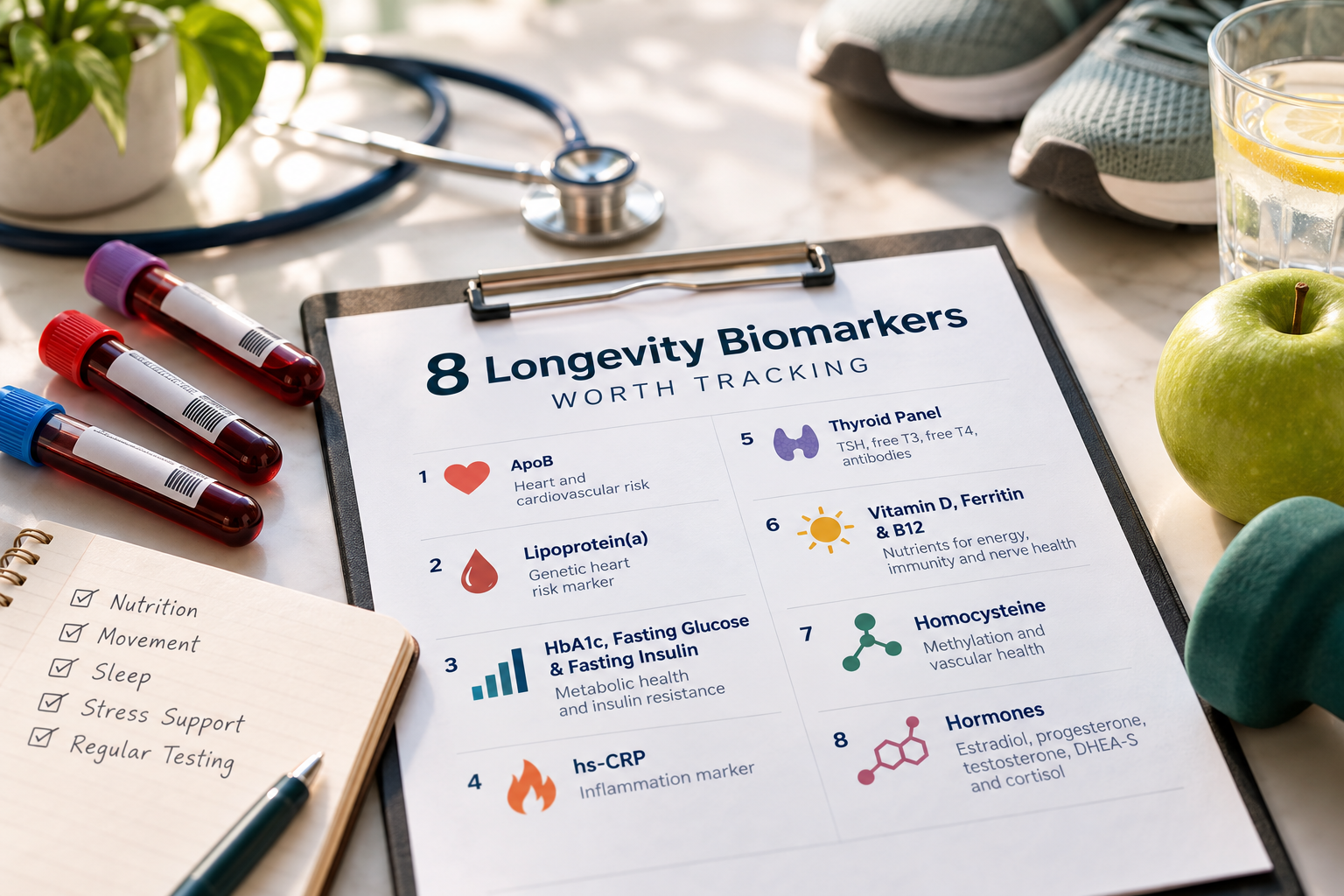
Discover eight important blood biomarker categories that can help evaluate cardiovascular, metabolic, hormonal, and long-term health at Natural Care Institute in Birmingham, Michigan.
Longevity Biomarkers: 8 Blood Tests Worth Tracking
By Jill Skurnowicz, ND, MS, CRNA
“Biological age” tests, longevity panels and at-home blood kits are everywhere right now. Some of it is useful and some is expensive noise. At Natural Care Institute in Birmingham, MI, patients often ask me which longevity biomarkers are worth tracking. The honest answer: a handful of well-studied blood markers tell you far more than a flashy “age score.” Here are the eight I find most useful, and how to put them in context.
What Are Longevity Biomarkers?
Longevity biomarkers are measurable signs, usually from blood, that reflect your risk for age-related conditions such as heart disease, type 2 diabetes, cognitive decline and chronic inflammation. They don’t predict how long you’ll live. They show where your body is trending, early enough that nutrition, movement, sleep and targeted care can change the direction.
8 Longevity Biomarkers Worth Tracking
- ApoB. This counts the cholesterol-carrying particles that can enter artery walls. Many experts consider it a more precise cardiovascular risk marker than LDL cholesterol alone.
- Lipoprotein(a), or Lp(a). This is largely genetic and often missed on routine panels. Most people only need it measured once, and a high result changes how aggressively we manage heart risk.
- HbA1c, fasting glucose and fasting insulin. Insulin often rises years before glucose does. Catching insulin resistance early supports energy, weight, hormone balance and brain health.
- hs-CRP. High-sensitivity C-reactive protein is a general inflammation marker. A persistently elevated level is a reason to look for a source, such as gut, dental, metabolic or toxin-related triggers.
- Thyroid panel (TSH, free T3, free T4, antibodies). Thyroid function affects metabolism, mood, cholesterol and energy. Standard screening often stops at TSH alone.
- Vitamin D, ferritin and B12. Low or very high levels of these nutrients are common and fixable. They influence immunity, energy, mood and nerve health.
- Homocysteine. Elevated homocysteine can point to methylation or B-vitamin issues and is associated with vascular and cognitive risk. It’s a useful link between lab results and root-cause care.
- Hormones: estradiol, progesterone, testosterone, DHEA-S and cortisol. Shifts in these hormones shape bone, muscle, cognition and cardiovascular health in both women and men, particularly through perimenopause and andropause.
What About “Biological Age” Tests?
Epigenetic and blood-based “biological age” clocks are interesting research tools, but they aren’t yet validated to guide individual medical decisions. Results can vary between labs and between repeat tests. I’d use them, if at all, as a motivator, never in place of the markers above. Beyond bloodwork, strength, VO2 max, sleep quality and body composition are some of the strongest predictors of healthy aging.
How to Use Your Results
A number only means something in context. Standard lab ranges flag disease; they don’t always flag early drift. In functional medicine we look at optimal ranges, trends over time and your symptoms and history together. If a result is off, the next question is why. See our guide to blood tests your doctor may be missing (https://naturalcareinstitute.com/blood-tests-for-fatigue/) for a place to start, and read what functional medicine is (https://naturalcareinstitute.com/what-is-functional-medicine/) to see how we connect the dots.
Results can also guide support for cellular energy. Some patients explore NAD+ therapy (https://naturalcareinstitute.com/nad-iv-therapy-birmingham-mi/), and many prefer our subcutaneous (SubQ) injections because they skip the 2-4+ hour infusion chair time. Hormone shifts after 40 are another common thread; see why women gain weight after 40 (https://naturalcareinstitute.com/why-women-gain-weight-after-40-hormone-connection-explained/), and if you’re on a GLP-1 medication, protecting lean mass (https://naturalcareinstitute.com/glp-1-muscle-loss-birmingham-mi/) belongs on your radar too.
Frequently Asked Questions
What are the best longevity biomarkers to test?
ApoB, Lp(a), HbA1c with fasting insulin, hs-CRP, a full thyroid panel, vitamin D, ferritin and B12, homocysteine and key hormones give a well-rounded picture. Your history and family risks may add others.
How often should I test my longevity biomarkers?
Most people benefit from a baseline, then a recheck every 6 to 12 months, or sooner when making a significant change in diet, medication or treatment. Lp(a) is usually measured once.
Are biological age tests accurate?
Not reliably enough for individual decisions. Treat them as experimental, and rely on established markers and functional measures like strength and fitness.
Ready to See Your Numbers in Context?
If you live in or near Birmingham, MI and want a clearer picture of your health trajectory, I’d love to help you interpret your labs and build a plan. Book a consultation at naturalcareinstitute.com/appointments (https://naturalcareinstitute.com/appointments/) or call (248) 845-8516.
Disclaimer: This article is for educational purposes only and is not medical advice. It does not establish a patient-provider relationship. Talk with a qualified healthcare provider before making changes to your health care.