
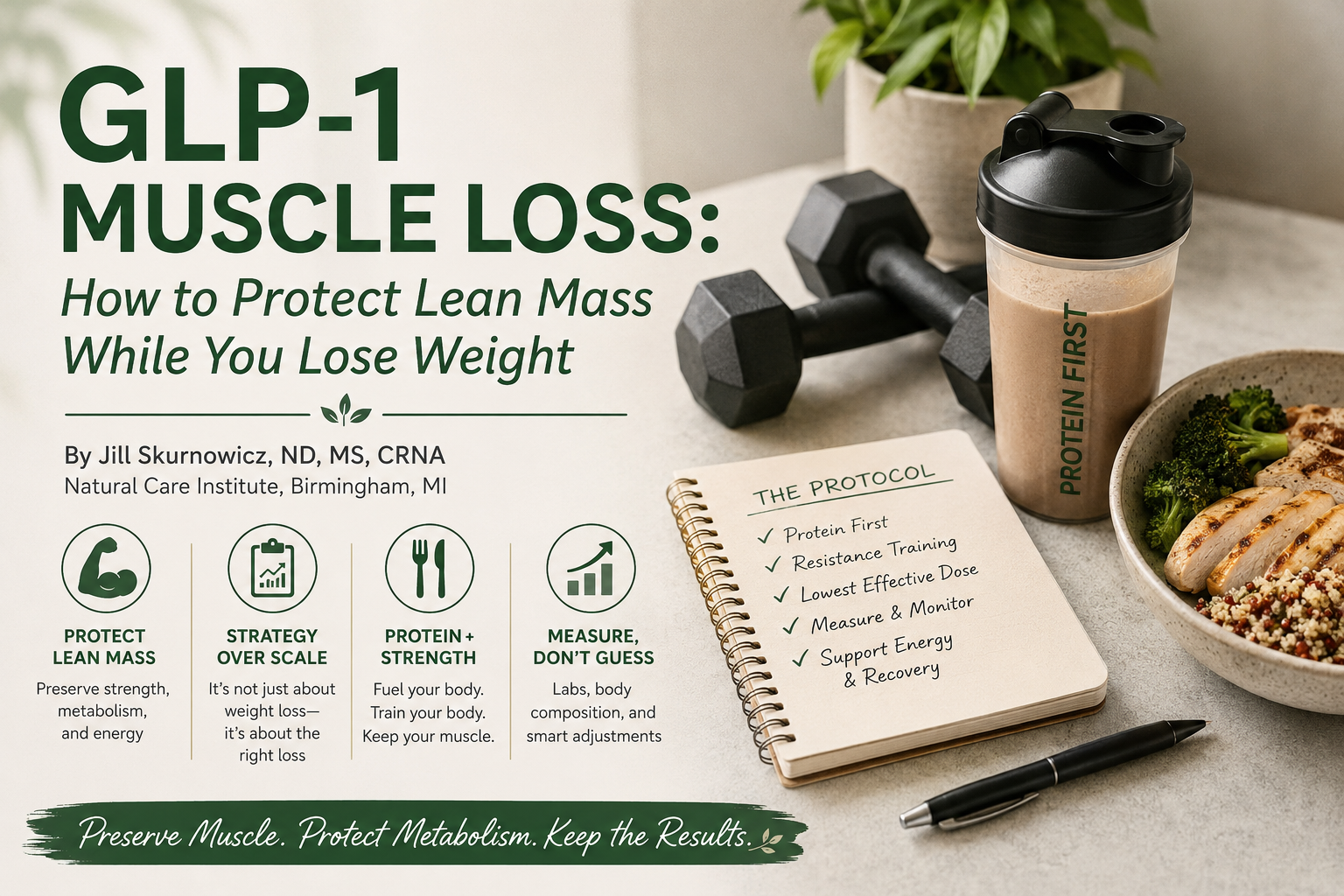
Protecting lean mass during GLP-1 weight loss requires adequate protein, progressive resistance training, appropriate dosing, and body composition monitoring.
GLP-1 Muscle Loss: How to Protect Lean Mass While You Lose Weight
By Jill Skurnowicz, ND, MS, CRNA | Natural Care Institute, Birmingham, MI
GLP-1 muscle loss has become the biggest question in weight management this year, and for good reason. The medications work – patients in my Birmingham office are seeing results they could not achieve on their own. But a growing number arrive having lost forty pounds and feeling weaker, flatter, and more fatigued than they expected. The scale moved. Their strength did not follow.
Here is what the research actually shows, and what I do differently for patients on these medications.
Why GLP-1 Muscle Loss Happens
Any significant weight loss costs you some lean tissue – that has always been true, whether the weight comes off through dieting, surgery, or medication. Your body does not burn fat exclusively.
What makes GLP-1 medications different is speed and appetite suppression working together. When food genuinely stops being interesting, most people do not just eat less – they eat less protein, because protein-rich foods are filling and unappealing when appetite is gone. Combine reduced protein intake with rapid weight loss and no resistance training, and muscle becomes an easy thing for the body to give up.
What the Trials Actually Found
The numbers vary more than headlines suggest, and it is worth being honest about that.
In a body-composition analysis of the STEP 1 semaglutide trial, lean mass fell by about 6.9 kg – roughly 45% of the total weight lost. In SURMOUNT-1 with tirzepatide, the split was about 75% fat and 25% lean mass – essentially the same ratio seen in the placebo group.
Some 2026 analyses argue the lean-mass loss is not disproportionate compared with any other method of losing that much weight. Others find it meaningful, especially in adults over 60 and anyone already low on muscle. My read: the concern is real but not a reason to avoid the medication. It is a reason to manage it properly.
Why it matters practically: every kilogram of muscle you lose drops your resting energy expenditure by roughly 13 calories a day, versus about 4 calories per kilogram of fat. Lose too much muscle and you make regain easier – the exact opposite of the goal.
Outbound links to add in WordPress: dom-pubs.onlinelibrary.wiley.com/doi/10.1111/dom.15728 (STEP 1) and dom-pubs.onlinelibrary.wiley.com/doi/10.1111/dom.16275 (SURMOUNT-1)
The Protocol I Use With Patients on GLP-1s
- Protein first, non-negotiable. Target 1.2 to 1.6 grams per kilogram of body weight daily. For most of my patients that means 100 to 140 grams, which requires actual planning when appetite is suppressed. Front-load it at breakfast.
- Resistance training two to three times a week. Not walking. Not Pilates alone. Loaded, progressive strength work is the single strongest signal telling your body to keep the muscle.
- Lowest effective dose, escalated slowly. Faster is not better. If you are losing more than about 3.3 pounds a week, that is a signal to hold the dose, not celebrate.
- Measure, don’t guess. Body composition tracking plus labs – thyroid, ferritin, vitamin D, B12, A1c, and a full hormone panel. If your thyroid or hormone picture is off, you will lose more muscle and feel worse doing it.
- Support energy and recovery. Many patients on GLP-1s undereat overall, not just protein. Subcutaneous NAD+ injections and peptide therapy can support energy and recovery during a demanding phase – and the SubQ route means no two-to-four-hour infusion chair.
This is the difference between a medication and a program. A med spa can hand you a semaglutide injection. Nobody there is checking whether the weight you lost was the weight you wanted to lose.
Internal links to add in WordPress: /why-women-gain-weight-after-40-hormone-connection-explained/ | /nad-iv-therapy-birmingham-mi/ | /peptide-therapy-birmingham-mi-2/ | /experience-the-power-of-semaglutide-and-b12-revitalize-your-energy-and-ignite-weight-loss/
Frequently Asked Questions
Does GLP-1 muscle loss reverse after I stop?
Muscle can be rebuilt, but it takes deliberate resistance training and adequate protein – it does not return on its own. This is why protecting it during treatment is far easier than recovering it afterward.
How much protein do I really need on semaglutide?
Most adults do well at 1.2 to 1.6 grams per kilogram of body weight per day. If appetite suppression makes that hard, protein shakes and Greek yogurt are practical tools, not shortcuts.
Can I build muscle while losing weight on a GLP-1?
Some people can, particularly those new to resistance training. For most, the realistic goal is preserving what you have while fat comes off – which is a genuine win.
Let’s Make Sure You’re Losing the Right Weight
If you are on a GLP-1 or considering one, the medication is the easy part. The strategy around it determines whether you end up leaner and stronger or just smaller and tired.
Schedule a consultation at naturalcareinstitute.com/appointments/ or call (248) 845-8516. We can review your labs, your protein intake, and your dosing plan together.
This article is for educational purposes only and does not constitute medical advice, diagnosis, or treatment. Do not start, stop, or change any prescription medication without consulting your healthcare provider.