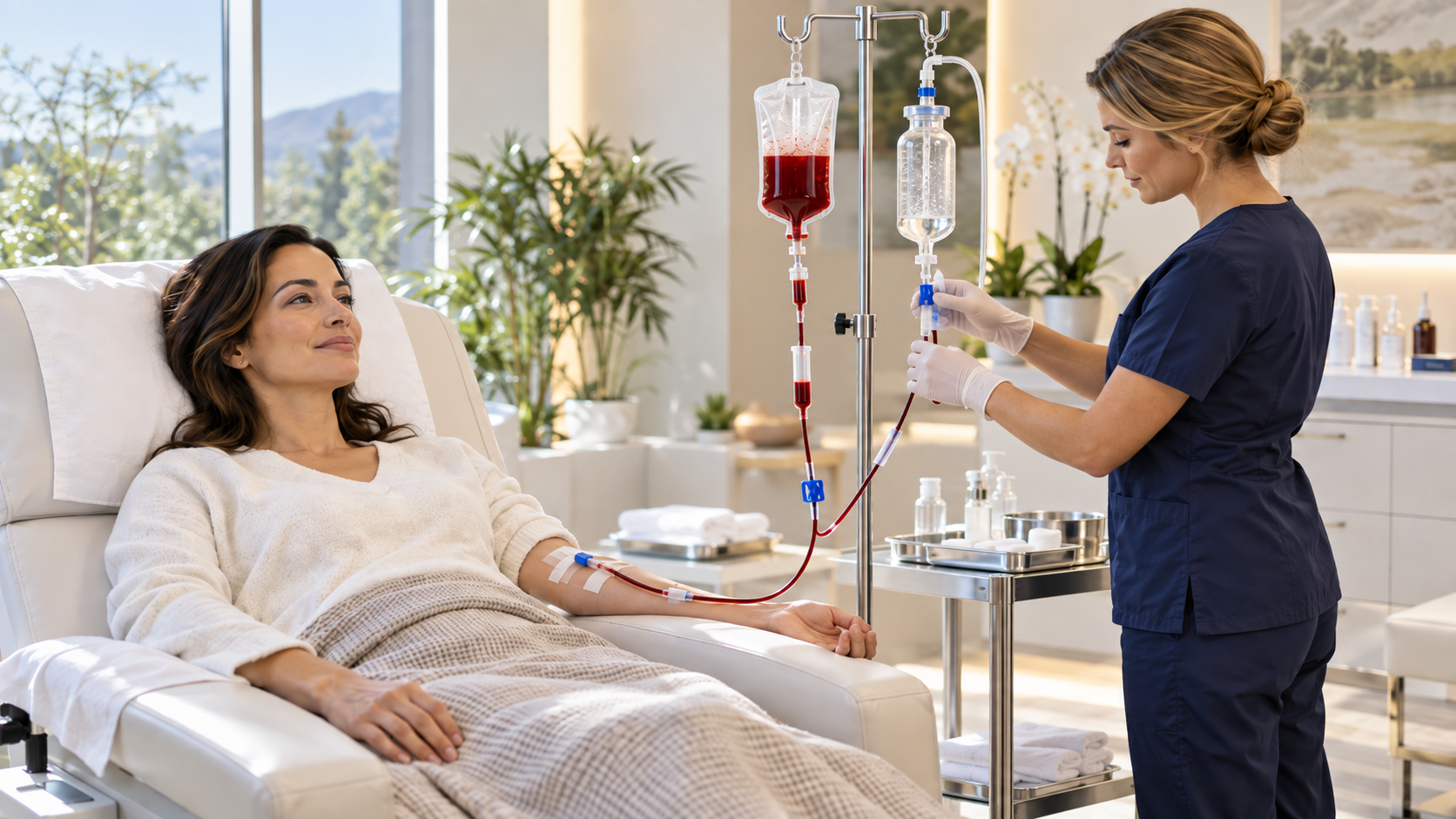
Ozone autohemotherapy is one method of administering ozone therapy. Learn about the research, potential risks, and clinical considerations at Natural Care Institute in Birmingham, MI. AI-generated illustration.
Ozone Therapy in Birmingham, MI: What the Science Says
By Jill Skurnowicz, ND, MS, CRNA | Natural Care Institute, Birmingham, MI
Ozone therapy has quietly become one of the most talked-about treatments in regenerative medicine. Longevity clinics, athletes, and wellness influencers are all posting about it, and I now get questions about it nearly every week in our Birmingham office. Some of the enthusiasm is warranted. Some of it is marketing. As someone who has placed IVs for more than 32 years and who offers ozone in my own practice, I want to give you the version that is honest about both.
What Is Ozone Therapy and How Is It Given?
Ozone (O3) is oxygen with a third atom attached, which makes it a powerful oxidizer. That sounds like a bad thing, and in the lungs it is. Medical ozone works differently: a small, precisely measured dose is mixed with your own blood or with saline outside the body, and the treated fluid is returned through a standard IV line. Your cells respond to that brief, controlled oxidative signal by ramping up their own antioxidant systems, including glutathione, and by modulating immune messengers called cytokines.
The most common forms you will see include major autohemotherapy (ozonated blood returned by IV), ozonated saline, single-pass ozone combined with ultraviolet blood irradiation (UVBI), and intramuscular ozone injections for localized pain. Ozone gas is never injected directly into a vein at Natural Care Institute, for reasons I explain below.
What the Research Actually Supports
The evidence base is real but uneven, and I think patients deserve to know exactly where it stands.
The strongest data are for chronic wounds. A 2026 umbrella review of randomized trials found consistent benefit for diabetic foot ulcers, chronic periodontitis, and healing after oral surgery. A 2026 meta-analysis of ozone autohemotherapy for shingles-related nerve pain reported meaningful reductions in pain and improved sleep with a favorable safety profile.
For the reasons most people ask me about it, such as fatigue, post-viral symptoms, fibromyalgia, and immune support, the studies are smaller and mostly observational. Early reports on post-COVID fatigue and fibromyalgia are encouraging but not definitive. A 2025 scoping review of ozone for pain and fatigue in cancer patients concluded the same thing: promising signals, but most trials enrolled 30 people or fewer. Ozone is not a cancer treatment and should never replace oncology care.
Where ozone fits well, in my experience, is as one tool within a functional medicine plan, alongside targeted IV nutrients, mitochondrial support, and root-cause lab work.
Is Ozone Therapy Safe?
Two facts belong side by side here. First, the FDA has not approved ozone for any medical use and considers ozone gas toxic when inhaled. Second, the serious complications reported in the literature, including gas embolism, are almost entirely associated with direct injection of ozone gas into the bloodstream or improper technique. That is precisely why the method matters more than the marketing.
At our clinic, ozone is administered under physician medical direction using closed systems, and every IV is placed by me or a nurse I have personally trained. Numbing is always included, so placement is painless. We screen for conditions where ozone is inappropriate, including G6PD deficiency, hyperthyroidism, pregnancy, and active bleeding disorders. If you are comparing providers in Oakland County, ask who is placing the line and what their IV credentials are.
Who Tends to Benefit Most
Patients who do best are usually those with chronic inflammation, recurrent infections, slow-healing tissue, lingering post-viral fatigue, or joint and back pain that has not responded to the usual approaches. Most start with a series of treatments over several weeks, then shift to maintenance as needed. Many combine ozone with our painless IV therapy (https://naturalcareinstitute.com/painless-iv-therapy-birmingham-mi/) formulas, an IV glutathione (https://naturalcareinstitute.com/iv-glutathione-therapy-birmingham-mi/) boost, or NAD+ therapy (https://naturalcareinstitute.com/nad-iv-therapy-birmingham-mi/), which we most often give as a quick subcutaneous injection rather than a multi-hour infusion. If you are new to the root-cause approach, start with what functional medicine is (https://naturalcareinstitute.com/what-is-functional-medicine/) and how it differs from conventional care.
Frequently Asked Questions
Does ozone therapy hurt?
No. The treatment uses a standard IV line, and numbing is always included at Natural Care Institute. Most people read or relax for the 30 to 60 minutes it takes.
How many ozone therapy sessions are needed?
It depends on the goal. Wound-healing and pain protocols in published studies typically run 6 to 12 sessions. We set a plan at your consultation and adjust based on how you respond.
Is ozone therapy covered by insurance?
No. It is considered an elective, non-FDA-approved treatment, so it is self-pay. Sessions at our office start at $250, with pricing confirmed at your consultation.
Ready to Learn More?
If you are curious whether ozone therapy fits your health goals, schedule a consultation at naturalcareinstitute.com/appointments (https://naturalcareinstitute.com/appointments/) or call (248) 845-8516. We are located at 1925 Southfield Road in Birmingham, minutes from Bloomfield Hills, Royal Oak, and Troy.
This article is for educational purposes only and is not medical advice. Ozone therapy is not FDA-approved and is not intended to diagnose, treat, cure, or prevent any disease. Please consult your physician before starting any treatment.
____________________________________________________________
RESEARCH SOURCES (for your reference; link 2-3 in the post if desired)
- Umbrella review of ozone therapy RCT meta-analyses (Medicina, 2026): https://www.mdpi.com/2076-3271/14/2/289
- Ozone autohemotherapy for zoster-associated pain, meta-analysis (Frontiers in Neurology, 2026): https://www.frontiersin.org/journals/neurology/articles/10.3389/fneur.2026.1812211/full
- Ozone for pain, fatigue, anxiety, depression in cancer patients, scoping review (Frontiers in Psychology, 2025): https://www.frontiersin.org/journals/psychology/articles/10.3389/fpsyg.2025.1687754/full
- Major ozone autohemotherapy in post-COVID syndrome (PMC): https://pmc.ncbi.nlm.nih.gov/articles/PMC12946084/
- Cleveland Clinic overview of ozone therapy and FDA status: https://health.clevelandclinic.org/ozone-therapy