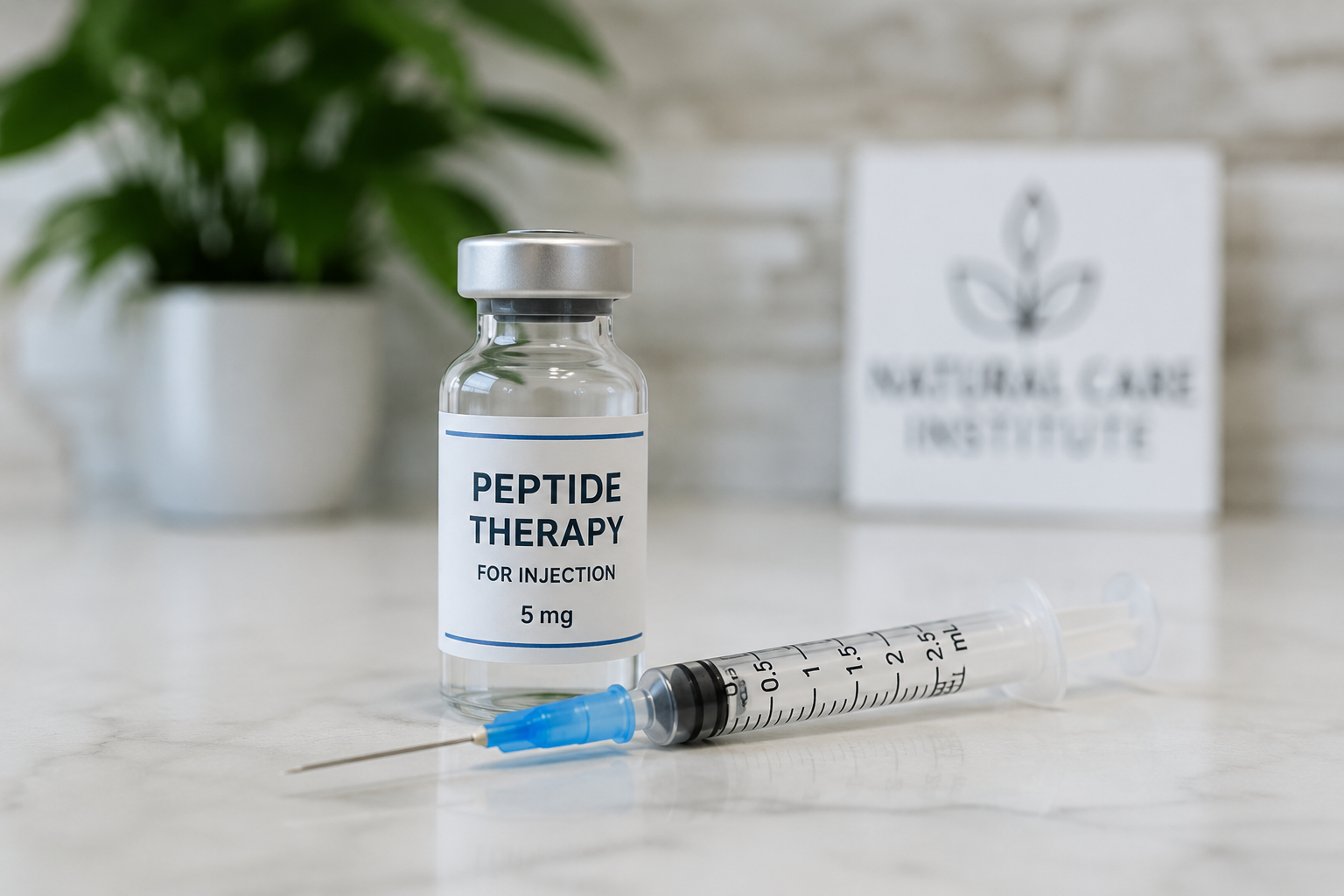
Peptide therapy is an emerging area of regenerative medicine that may support tissue repair, recovery, and overall wellness when used under appropriate medical supervision.
Peptide Therapy in Birmingham, MI: What the Science Really Says
By Jill Skurnowicz, ND, MS, CRNA | Natural Care Institute, Birmingham, MI
If you follow wellness podcasts or scroll health content online, you have probably heard someone rave about peptide therapy and names like BPC-157 or TB-500. Athletes credit peptides for faster recovery, and longevity enthusiasts talk about them like the next frontier in anti-aging. At Natural Care Institute in Birmingham, MI, patients ask us about them almost every week. So let’s separate the genuine science from the social-media hype.
What Are Peptides, Really?
Peptides are short chains of amino acids — the same building blocks that make up proteins. Your body already produces thousands of them to signal cells, regulate hormones, support immunity, and coordinate healing. Because they act as biological “messengers,” specific peptides can, in theory, nudge the body toward repair, better metabolism, or reduced inflammation.
That is the appeal. It is also why peptides are having a moment in functional and regenerative medicine. But “your body makes them naturally” is not the same as “any peptide is safe or proven for any use.” The details matter.
How Peptide Therapy Works
The most talked-about peptide right now is BPC-157, a synthetic version of a compound originally identified in gastric juice. In preclinical and animal research it has shown a striking ability to support tissue repair — tendons, ligaments, muscle, and the gut lining — and to calm inflammation. That research is why people reach for it for chronic joint pain, post-surgical recovery, and gut issues.
Here is the honest caveat: most of that evidence comes from laboratory and animal studies. Large, high-quality human trials are still limited. In fact, BPC-157’s regulatory status is actively evolving — the FDA’s Pharmacy Compounding Advisory Committee is scheduled to review it later this month. Promising is not the same as proven, and a responsible provider will tell you exactly where the science stands rather than overselling a result.
Peptides and Regenerative Medicine
Peptide therapy fits within a broader regenerative approach that we already use at our Birmingham practice — one focused on giving the body the raw materials and signals it needs to repair itself. That same philosophy drives our IV and injection therapies (naturalcareinstitute.com/iv-therapy-in-birmingham-mi) and our work with NAD+ for cellular energy and healthy aging (naturalcareinstitute.com/nad-iv-therapy-birmingham-mi).
A quick note on comfort and convenience, since it comes up often: many regenerative treatments don’t require hours in an infusion chair. We frequently use subcutaneous injections — including for NAD+ — because a small under-the-skin injection avoids the 2-to-4-hour IV drip while still delivering results. If needles make you nervous, our painless approach to IV therapy (naturalcareinstitute.com/painless-iv-therapy-birmingham-mi) applies here too.
Are Peptides Right for You?
This is where a personalized, root-cause evaluation matters. Peptides are not a shortcut around good sleep, balanced hormones, nutrient status, and blood sugar control — the foundations we assess in every functional medicine (naturalcareinstitute.com/what-is-functional-medicine) work-up. For some patients, addressing those basics resolves the joint pain or fatigue that sent them searching for peptides in the first place.
Peptide therapy should only be considered under medical supervision, using properly sourced products, with clear goals and honest expectations. Products marketed “for research only” online are exactly what we steer patients away from.
Frequently Asked Questions
Is peptide therapy FDA approved?
It depends on the peptide. Several are not FDA approved, and some — including BPC-157 — are under active regulatory review. That is precisely why medical guidance and reputable sourcing matter so much.
What is BPC-157 used for?
People use it for tissue and tendon repair, joint pain, post-surgical recovery, and gut health. The supporting evidence is mostly preclinical, so we discuss it as promising but not proven.
Are peptides safe?
Peptides obtained without oversight or from unregulated “research” suppliers carry real risks. Any consideration of peptide therapy should happen with a qualified provider who evaluates your full health picture first.
Let’s Talk About Your Goals
Curious whether peptide therapy or another regenerative option fits your health goals? We’d rather give you a straight, science-based answer than a sales pitch. Schedule a consultation (naturalcareinstitute.com/appointments) at Natural Care Institute in Birmingham, MI, or call us at (248) 845-8516.
This article is for educational purposes only and is not medical advice. It does not diagnose, treat, or cure any condition, and no specific outcome is promised. Please consult a qualified healthcare provider before starting any new therapy.