
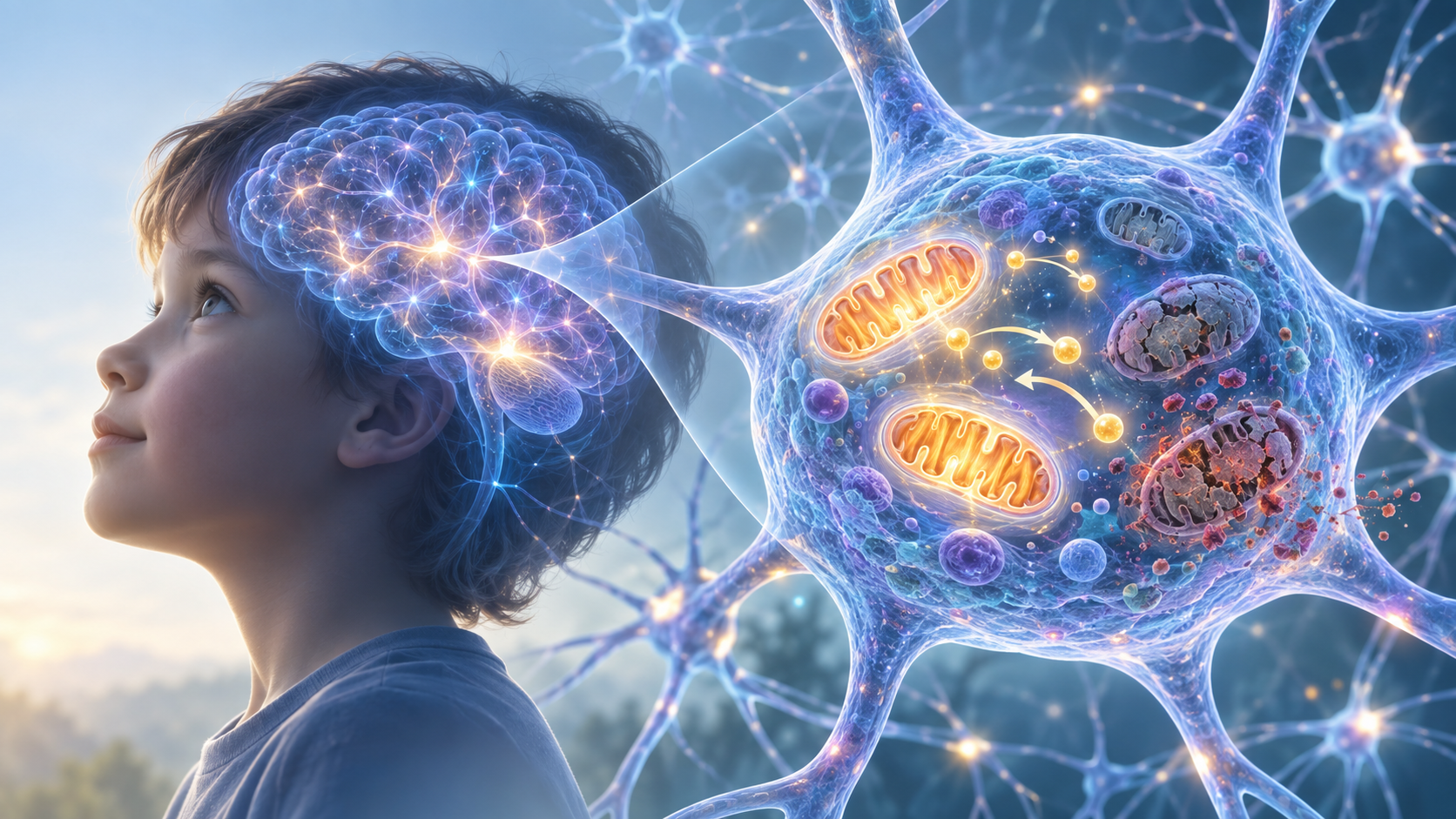
Mitochondrial dysfunction may affect cellular energy production and neurological function in some individuals with autism.
Mitochondrial Dysfunction Autism: What Parents Should Know
By Jill Skurnowicz, ND, MS, CRNA | Natural Care Institute, Birmingham, MI
Mitochondrial dysfunction autism research has been in the headlines this month, and for good reason. On August 28, scientists at UC San Francisco published the largest-ever map of how autism-linked genes disrupt shared protein “hubs” inside brain cells. A separate July 2026 review in Molecular Neurobiology argued that mitochondrial stress may explain why some children respond poorly to standard therapies. If your child has autism and struggles with fatigue, regression after illness, or unexplained GI trouble, this science may hit close to home.
Here is what the research says, what it does not say, and how we approach it at our Birmingham office.
What Mitochondria Do (and Why Autism Researchers Care)
Mitochondria are the tiny power plants inside almost every cell. They convert food and oxygen into ATP, the energy currency your brain, gut, and muscles run on. The brain is the hungriest organ in the body, using roughly 20% of total energy, so neurons are the first to feel it when energy production falters.
Classic mitochondrial disease is rare. What researchers see in a meaningful subset of children with autism is different: not a single broken gene, but reduced efficiency. Post-mortem studies have found lower activity of electron transport chain complexes I, III, and V in the frontal cortex, temporal lobe, and cerebellum. Blood work in some children shows patterns like elevated lactate, low carnitine, or abnormal lactate-to-pyruvate ratios.
Mitochondrial Dysfunction Autism: What the Research Shows
Three findings stand out from 2026:
Shared molecular hubs. The UCSF team mapped more than 1,800 protein interactions across 100 autism risk genes, 87% of them new. Different genes repeatedly disrupted the same protein complexes. That matters because it suggests future treatments could target common pathways rather than one gene at a time.
Treatment resistance. The Molecular Neurobiology review proposed that mitochondrial stress switches on epigenetic programs that quiet neuroplasticity genes. In plain terms: when cells are chronically energy-starved, they may become less responsive to behavioral and medical interventions.
Gut involvement. A 2026 zebrafish model documented abnormal mitochondrial shape in the gut for the first time, adding to the gut-brain story I covered in The Gut-Brain Connection in Autism (https://naturalcareinstitute.com/autism-gut-health-brain-connection/).
An honest caveat: a 2026 Turkish genetic study found no link between mitochondrial DNA variants and autism. The dysfunction appears to be functional and acquired more often than inherited, and it does not apply to every child.
Signs Worth Investigating
Mitochondrial issues do not have a single look. Patterns I watch for in practice include:
- Low muscle tone, easy fatigue, or poor exercise tolerance
- Developmental regression, especially after a fever or illness
- Recurrent GI symptoms, reflux, or constipation without a clear cause
- Seizures or unusual sleep disruption
- A “good days and bad days” pattern that tracks with illness, stress, or food
None of these confirms a mitochondrial problem. They are reasons to test rather than guess.
How We Evaluate It in Birmingham
At Natural Care Institute, we start with a targeted lab panel: fasting lactate and pyruvate, plasma amino acids, total and free carnitine, acylcarnitine profile, CoQ10, ammonia, and organic acids. We also check folate metabolism, because low cerebral folate overlaps with mitochondrial symptoms, as I discussed in Folinic Acid for Autism (https://naturalcareinstitute.com/folinic-acid-autism/).
Support is then matched to the findings. Evidence-supported options include L-carnitine when levels are low, CoQ10, B vitamins, and antioxidant support. Glutathione, the body’s main mitochondrial antioxidant, is frequently depleted in autism, which is why families ask about IV glutathione therapy (https://naturalcareinstitute.com/iv-glutathione-therapy-birmingham-mi/).
For older teens and adults on the spectrum, NAD+ is a natural fit because it is the coenzyme mitochondria use to make energy. We favor subcutaneous NAD+ injections over IV infusions: the injection takes minutes, the IV takes two to four hours, and most patients tolerate SubQ far better. I covered the evidence in NAD+ Therapy: The Real Science (https://naturalcareinstitute.com/nad-iv-therapy-birmingham-mi/).
Frequently Asked Questions
Is mitochondrial dysfunction the cause of autism?
No. Autism has many contributing factors, including genetics and prenatal environment. Mitochondrial dysfunction is a feature seen in a subset of children, estimated in research at roughly 5% with confirmed disease and a larger share with milder biochemical abnormalities. It is a piece of the picture, not the whole picture.
Can supplements fix mitochondrial dysfunction in autism?
Supplements cannot “fix” it, and no one should promise that. Targeted nutrients like carnitine, CoQ10, and B vitamins have shown modest benefits in small trials, mainly for energy, GI symptoms, and irritability. Results vary, and testing first prevents wasted money on things your child does not need.
How do I get my child tested for mitochondrial dysfunction?
Ask a functional medicine or metabolic provider for a fasting metabolic panel that includes lactate, pyruvate, carnitine, and acylcarnitines. Complex cases may be referred to a geneticist or metabolic specialist for muscle biopsy or genetic sequencing.
Take the Next Step
If your child’s energy, behavior, or gut symptoms have never fully made sense, a metabolic workup may give you answers. We serve families throughout Birmingham, Bloomfield Hills, Royal Oak, and the greater Oakland County area.
Schedule a consultation at naturalcareinstitute.com/appointments (https://naturalcareinstitute.com/appointments/) or call (248) 845-8516.
This article is for educational purposes only and is not medical advice. It does not replace an individualized evaluation. Talk with your child’s healthcare provider before starting or stopping any supplement or therapy.
Sources
- UCSF protein interaction map, Science, Aug. 28, 2026: https://www.science.org/doi/10.1126/science.ady4523 (summary: https://www.disabilityscoop.com/2026/09/01/study-may-point-way-to-new-autism-treatments/32153/)
- Liu D, et al. Mitochondrial-Epigenetic Crosstalk in Autism Spectrum Disorder. Mol Neurobiol. 2026;63(1):776. https://pubmed.ncbi.nlm.nih.gov/42467385/
- Mitochondrial Dysfunction in Autism and ADHD: Evidence from Genetic, Biochemical, and Neuroimaging Approaches. 2026. https://pmc.ncbi.nlm.nih.gov/articles/PMC13295364/
- Aykutlu et al. No Association Between ASD and Mitochondrial DNA Variants. Int J Dev Neurosci. https://onlinelibrary.wiley.com/doi/10.1002/jdn.70100